Monday, May 5, 2008
Again with the terrible people...

Thursday, April 17, 2008
Robert Altman
 This man has one of the most cynical views of the human race as anyone I've ever known. Of the movies that we watched, all of them included something about greed, deception, and murder. Seriously. I don't understand where he gets all of these ideas from. Maybe it's just that every experience he had with other people was a bad one. That's the only reason I can think of as to why he would have such a negative viewpoint.
As for something a little more reasonable, I can see where he gets his ideas about Hollywood for "The Player." If someone with such a cynical view on people already spends all of his time around the type of people that work in Hollywood then I can very easily see where he gets his inspiration for a movie about how horrible and corrupt the movie making industry is. Yeah.
~PSH
Thursday, March 20, 2008
Akira Kurosawa
Sunday, March 9, 2008
Purple Rose of Cairo
 Here's my thought. What the %$^#?
This is a movie about a movie character (not actor mind you) who magically walks off of the screen during a movie to run away with this girl so they can fall in love and kiss and then the screen will fade out just before they make love.
Well sorry Mr. Allen but I ain't buyin' it this time. Your other movies were funny, and although this one had it's moments, I have to say I don't know why it got good reviews. Where was the wit? The kind of humor that you have to think about? All of the things that I had found to be defining parts of Woody Allen's films were absent. All of the jokes were very uh...well I guess the only word I can use to describe them would be "American." That is to say they were instantly satisfying, a lot of one liners with no intelligence behind them. That and both the leading characters were idiots. Sure we're made to feel sorry for Cecelia but she's just a dumb broad who will believe anything the movie tells her.
Oh and I have a question: is there a movie in which Danny Aiello does NOT play an angry Italian guy who beats people up? Granted the only other movie I've seen him in was "Do The Right Thing" where he play an angry Italian guy. But really, if such a movie exists, please tell me.
~PSH
Sunday, March 2, 2008
Hitchcock's Favorite Device...
 The Macguffin. This is an item within the movie which drives curiosity and desire in order to progress the plot of the film. However, the actual identity of this item or person is unimportant to the viewer. For example, in "Vertigo" we have Carlotta Valdes. Her life and death are unimportant to the viewer, but the idea of her ghost haunting Madeleine Elster is the reason for Scottie's investigation, and the entire plot of the movie.
~PSH
Sunday, February 24, 2008
A Nervous Romance
Monday, February 18, 2008
Mighty Aphrodite
 Woody Allen is a funny man. Not sure I know of any other directors that could have made this movie work. It's about two people, Lenny and Amanda, who have adopted a son, Max, since they aren't willing to have their own children for some reason. The kid grows up and they discover that he is a genius. Lenny wants to meet Max's parents, and discovers that his real mother, Linda Ash, is a porn star and is the dumbest person he's ever met.
The thing that sells this movie for me is the fact that Allen decided to add a Greek Chorus to it. It adds a whole other level of hilarity to the movie. The typical Greek chorus is just there to keep the audience from getting too confused, because in ancient Greek theatre there were usually 2-3 actors on stage playing several parts. In Allen's movie, the chorus adds to the humor by actually interacting with the characters of the movie. Roger Ebert says:
Although the Greek chorus might seem an unwieldy addition to a Woody Allen comedy about modern Manhattan neurotics, the addition actually functions nicely. Chorus members including F. Murray Abraham, Olympia Dukakis and David Ogden Stiers make dire observations about the decisions Lenny is making, and their ironic counterpoint helps Allen get away with some of the more obviously mechanical plot developments.Even though it's a little unconventional, Allen's foray into Greek Tragedies was very successful, and makes for a very enjoyable movie. ~PSH
Thursday, December 20, 2007
"How come you ain't got no brothers up on the wall??"
Thursday, December 13, 2007
If Ali is fire, Mathieu is dry ice.
Subsidized by the Algerian government, the movie began as a sketchy screenplay written in a French prison by Saadi Yacef, the rebel leader of the Algerian National Liberation Front (FLN). Upon his release, Yacef approached three filmmakers: Luchino Visconti, Francesco Rosi, and Pontecorvo (demonstrating that, whatever else might be said about them, some revolutionaries have good taste in movie directors). Yacef not only became the film’s producer but also stars in it as El-hadi Jaffar, the military leader of the FLN.So you see the movie wouldn't have even existed if it weren't for that. Second, this guy basically wrote the movie based on stuff he had planned. The bombings of the two cafes and the Air France ticket office. These are things that Yacef himself had helped to plan. This movie really helped to show me that this kind of warfare is real. Every time I hear on the news about another roadside bombing or a car bombing, I really do think about the fact that there are casualties. The way these things are presented in the media doesn't really leave much to think about. I think after a while you just become desensitized to the fact that there is a lot of shit going on in the world. But after seeing the scene's in the two cafes with those close up shots of the little kid eating his ice cream, I can't help but think about that little kid when I hear about a bombing on the news. It's just really hard for me to think that this stuff happens and there isn't really a whole lot anyone can do about it. The author of this article seems to have mentioned everything there is possible to mention about this movie. Except...no, he didn't. I'm interested in knowing a little more about the publics initial reaction to this movie. It is mentioned that the movie was used as a training video, which is interesting. That must be quite a compliment to the director to hear that his movie was so good that people are using it to learn how to do their jobs better.
What reveals Pontecorvo as an artist, and not simply a propagandist of genius, is the sorrow he tries to stifle but that comes flooding through anyway—the sense that all sides in this conflict have lost their souls, and that all men are carrion.
Wednesday, November 28, 2007
The times they are a changin'...i guess...
Monday, November 19, 2007
H-Bombs, Flaming women, Mike Hammer...oh my?
Tuesday, November 13, 2007
"What do you want?" ::::SMACKDOWN::::
Overall I liked Out of the Past. It kept me interested right up to the end. I wasn't really sure where the plot was going or what was going to happen. I think Jeff was my favorite character. He seemed like the guy who had his head on the straightest. Not to mention the fact that he took that guy out with one left hand to the face. The other characters were all too wishy-washy for me, especially Kathie. I mean, what a...well...the word I would use is inappropriate, but you can probably guess. She was just way too two-faced, and manipulative. I guess I’m a little confused about the plot though. So at first what we’re getting is Jeff’s account of the past? And then later we’re getting what’s going on in the present? Could somebody clarify please??
~PSH
Wednesday, November 7, 2007
What a lousy way to escape your problems...


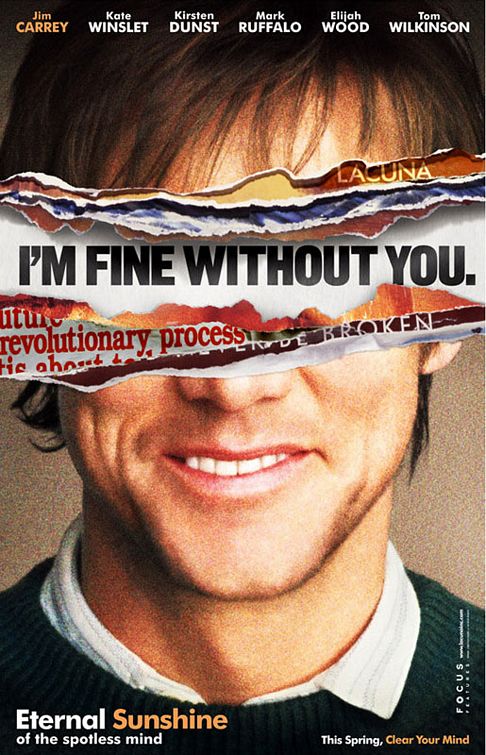
Eternal Sunshine of the Spotless Mind provokes a lot of thought. It brings to mind one question: would you erase someone? I feel like this is a very counterproductive process. The only thing that can result is the exact same thing that you were trying to avoid. I also think that erasing your memories is a risky thing because memories are part of what forms what kind of person you are. If you erase a memory, then you've effectively erased part of who you are. Depending on what you take away, it might not be something that you could re-learn, therefore changing who you are completely. Basically, erasing my memory is something that I would never do, no matter how horrible the memory is. I don't believe that taking something like that away could make your life any better. In the case of this movie, it's never really stated what happened to Clem and Joel. It's touched on at the end of the movie when the last seems to repeat indefinitely, indicating that they go through the same process of erasing each other and dating again. It's really a matter of opinion though, because they might feel like this is the best thing they can do with their lives...
~PSH
Wednesday, October 31, 2007
Hey wait a minute...could you repeat that please??
Wednesday, October 24, 2007
Hmm...welll...yeah...
Sunday, October 21, 2007
Hmm...This seems fitting...

I'm here to write about West Side Story, the movie version. Few movies (or musicals) have as well known of a musical score as West Side Story does. First, a little background. Originally, written in 1949 and titled "Gangway", then later re-titled "East Side Story", the musical was about a Catholic boy (Tony) and a Jewish girl (Maria), with conflicts set around anti-Semitism. The writers (Arthur Laurents and Jerome Robbins) decided that the story was dated, and the musical was put aside for about 5 years. Then in 1954, after a new wave of Puerto Rican immigrants and reports of gang fights, the title was changed to "West Side Story" and featured a Polish-American (Tony) and Maria's role changed from Jewish girl to a Puerto Rican. Now, on to the music. I believe this is the sole thing that makes WSS such a memorable movie. Without such a great score, it’s basically just another movie about racism. It was written and orchestrated by Leonard Bernstein. Bernstein, being the musical genius that he is, pretty much wrote the entire story with notes. In the very opening scene, the first thing that we hear is an augmented fourth, or a “tri-tone.” Basically what that means is that you take a perfect 4th and raise the top pitch a half step. The result is a very tense sounding chord, which Bernstein used to represent the tension between the Jets and the Sharks. So you see, before the movie even starts, you get ideas for what’s going to happen just based on the music that you hear while the 2 gangs are dancing.
And of course, Bernstein gave certain characters their own kind of “theme song.” The most recognizable of which is probably “Maria.” Here’s another instance of the augmented 4th in action. The beginning line of the tune utilizes this same chord, signifying that even though their love for each other is strong, there is still turmoil.
One of my favorites has to be the musical backing that Bernstein wrote for “The Rumble.” Loosely based off of Stravinsky’s “The Rite of Spring,” this piece uses many jagged rhythms and “ugly” chords to accentuate what’s happening on stage.
Another thing that makes this movie so unique is the orchestration that Bernstein wrote for. The score called for 5 woodwind players (all doubling on multiple instruments mind you), seven brass players, three percussionists, a pianist, a guitarist, and twelve string players!
Overall, the music in this film basically makes the movie. Like it said, without the music, this movie would be nothing. Over the years, there have been many artists that have recorded “tributes” to this great music. Oscar Peterson and his Trio recorded their take on it in 1962, and Bernstein decided to re-record the music in the late 1980’s, and a documentary was made on the recording process.
In closing, Leonard Bernstein is one of the greatest musical minds to ever have lived, and his composing was the greatest contribution to the success of this film.
~PSH
Wednesday, October 10, 2007
I didn't think they were that bad...maybe I was wrong...
Friday, October 5, 2007
Is there anybody going to listen to my story...
 Seeing that this is a film blog, and I just saw a film, I feel obligated to write about it. I just saw Across the Universe. And all I can say is....please go see this movie. The entire soundtrack is music from The Beatles. It's possibly the best movie I have seen ever. And I say that about a lot of movies...but this time I mean it. Even if you don't like The Beatles (is that possible???), I guarantee you will like this movie.
~PSH
Wednesday, October 3, 2007
Rosebud...
 "It's his sled. It was his sled from when he was a kid. There I just saved you two long boobless hours."
But seriously, I enjoyed this movie a lot. Normally if I'm flipping through TV channels and come across and old black and white movie like this one, I'd probably change the channel. But that would not be the case if I were to come across Citizen Kane. It's a very engaging story and keeps you hooked until the very last shot.
One of the ways this is accomplished is through the use of perspective relations throughout the movie, specifically deep focus. This kind of camera work is used to give the audience more information about Kane. For example, when he is forced to sign away his fortune, he is filmed in such a manner that when he walks all the way to the back of the room, all of a sudden he looks tiny, as if to say that he doesn't know or care about what's going on. Another good example of this is when he argues with Susan Alexander. This scene is filmed from a low angle and makes Kane seem HUGE when compared to Susan.
Overall, Welles and his production team did a wonderful job of making the characters true identities shown through the use of different camera angles and filming techniques.
~PSH
Monday, October 1, 2007
Pan's Labyrinth-A Fairy Tale that's not for small children???
 Upon viewing the first five minutes of Guillermo del Toro's Pan's Labyrinth, my first thoughts were, "oh this might be kinda cute." Of course, these thoughts were almost immediately beaten to a bloody pulp. This is probably one of the most violent movies I have seen in a while.
I do have to say though, it is very good movie. The first few minutes suggest that it will be a nice fairy tale much like you would tell to your children. It's a story about Ofelia (Ivana Baquero), who finds out that she is actually the reincarnation of the daughter of the king of the underworld. She is brought with her mother to her stepfather Vidal's (Sergio Lopez) outpost. He is a general in the Spanish army during the Spanish Civil War. Ofelia is told that in order to reclaim her throne as princess of the underworld, she must complete 3 tasks by midnight of the third day or all of the underworld will die. Sounds pretty rational right? Right. del Toro does a good job of playing this entire plot out right down to the very last detail, and leaves it with plenty of twists that'll leave you wondering.
Aside from the obvious parts, nothing in the movie seems to extravagant. It's all played out in such a way that makes it seem natural . The few conversations that Ofelia and her mother have with Vidal make the viewer just want to punch him in the face. You can definitely tell that hey do not get along very well. All of these things combine together to make for a relatively hopeless feeling towards Ofelia.
The acting in this film is very good. I say this only because of the performance given by Sergio Lopez. I discovered that the acting is good when you want to punch the character in the face, and that's exactly what happens with this particular character. His character is supposed to be this very mean, don't-take-shit-from-anybody kind of army general, and that's exactly what Lopez portrays. He even goes as far as to hit his little daughter.
The sets, naturally, are a little far fetched. It's not every day that a director calls for a giant slimy frog inside of a mud filled tree trunk. But that's exactly the kind of thing that you see in this movie. Obviously these play a critical part in the film, because of what the story is. It's a fairytale, so naturally there have to be some set that aren't exactly realistic.
One thing to take note of is the lighting that's associated with Vidal. Every time he is around the lighting is very low key. And he's never completely in the light. Either his face or some other part of his body is in the dark.
Overall I was very pleased with this movie. It's a good story, with a bit of excess gore. I feel that it would have been that much more enjoyable had del Toro decided to tone down the violence a bit.